![]() |
![]() |
![]() |
![]() |
|
|
|
|
|
|
|
|
|
|
|
|
|
|
|
|
|
|
|
|
| FESTIVALS | OPERA |
| Bath MozartFest | Robert Le Diable, Royal Opera House |
2012 saw the 21st birthday of the Bath Mozartfest which goes from strength to strength. One of the great benefits is of course the city itself and while we were there for the music, we were also able to visit the Thermae for the first time and indulge ourselves in the natural spa waters at the outdoor roof top pool even in mid-November, which is at a constant 46°.
The acoustic in the Assembly Room appears to amplify the sound and bounce it back from the ceiling. For the London Winds, on November 13, this meant that the impact was loud and warm if not always totally transparent. They opened with Mozart’s Serenade in C, a darkly brooding performance with an almost forced formality at times. Only the final variations brought any sense of daylight. By contrast Janacek’s Youth brought a playfulness and innocence which was both a relief and a delight. The single horn call at the start seemed to fill the hall with its brilliance and the Moderato was humane and joyful.
After the interval we heard an arrangement of three movements from Ravel’s Le Tombeau de Couperin, where the melancholic edge was offset by the dance rhythms. The anonymous arrangement of Beethoven’s Seventh Symphony was the festival rarity and made for a fine conclusion to the evening. The opening movement was hard driven and hard edged in tone, with a fiercely metallic sound from the oboe and an answering stridency from the clarinet. At times it sounded more like Berlioz than Beethoven. The slow movement brought some fine bassoon solo work but the final Allegro con brio seemed unnecessarily rushed. Just because a small ensemble can play faster does not always mean it is a benefit to do so. However, the arrangement brought us a new understanding of Beethoven’s construction and the delicacy of his part writing, so was well worth hearing.
The following lunchtime at the Guildhall brought the London Haydn Quartet in works by Haydn and Dvorák. The Guildhall’s acoustic is far crisper than the Assembly Room and allowed the most delicate of playing to be easily heard. They opened with Haydn’s Op76 No1, with its Schubertian touches and sublime slow movement. Haydn’s leaning towards romanticism here was well developed by the quartet and the Beethovenesque Menuetto and the playfulness of the final movement were very attractive.
Dvorák’s Op51 is clearly a favourite of the quartet, and their delight in playing it was visible throughout. The opening movement allows the melodic lines to grow and develop organically, combining a tight structure with a more relaxed dance motif. The gentle if slightly soporific Romanza proved a little too much for Catherine Manson, the lead violin, as she broke a string – ending the movement re-fingering the work across the remaining three. While she was restringing, James Boyd was able to talk to us briefly about their use of gut strings. The sound is far better for these works, particularly in the Guildhall’s acoustic, but the risk of breakage is all the higher. Safely restrung, the Finale proved irresistible.
My concerns about the relative acoustics of the two venues in Bath were born out that evening when we heard the Sitkovetsky Piano Trio in the Assembly Room. There was no doubting the exceptional quality of the playing, particularly in Beethoven’s Archduke Trio, but the quality of sound in the lower registers was noticeable by its lack of impact. Where the cello in the Guildhall was vibrant and firm all the way down, the cello here lacked impact in the lower octaves. Surprisingly the piano seemed to carry better though even that lacked some bass penetration.
All of which was a pity for the young players were in excellent form, opening with Mozart’s K548. Here the Andante cantabile was particularly effective, preparing us for the romantic fury of Brahms’ Op 101. The sudden richness of scoring and intensity of the sound was unexpected and all the more effective. The second movement brought little respite and only the lovely cantabile lines from the pianist in the Andante grazioso eased the mind. The final movement brings more tension though Brahms does allow us a slightly more optimistic conclusion. By contrast, the Archduke Trio was balm to the soul. The nobility and panache of the opening movement swept all before it until the final Allegro brings youth and hope. On the way the Andante cantabile seems so beautiful it is almost wasted on a Trio – if that is not heresy!
Pianist Alasdair Beatson is a late romantic at heart as his concert demonstrated in the Guildhall on Thursday lunchtime. Mozart’s Variations on Gluck’s Unser dummer Pobel meint K455 may be somewhat tongue-in-cheek but the grandeur that Alasdair Beatson brings to the work convinces us throughout. His bold and often aggressive playing makes the Steinway work for its money and singing out into the Guildhall across its full range and dynamic.
His approach to Schubert’s Wanderer Fantasy was equally dynamic, with its punchy bass chords and joyful exuberance. That the Adagio seems to prefigure Liszt was all the more obvious in the light of the rest of the programme which was given over to the composer’s arrangements of Schubert and Schumann. Du bist die Ruh made a gentle contrast with the fire of the Wanderer with its fine phrasing and pace. Gretchen am Spinnrade was romantically forceful and filled out with Lisztian runs and ornamentation. Schumann’s Widmung brought the concert to a warmly, if somewhat sentimental, conclusion, but one that was loved by all. Alasdair Beatson was so enthusiastically received that an encore was inevitable, and we heard Fauré’s Dance Caprice, its lighting shifting moods acting as a soufflé after the Liszt.
The English Chamber Orchestra provided a popular but none the less welcome programme at the Assembly Room that evening, opening with Mendelssohn’s String Symphony No 6. It is difficult to accept that a work of this complexity and style was composed by a twelve year old with no intention of publication, but such are the facts. Not only was the performance highly enjoyable but the precision the orchestra find without a conductor continues to impress. Two Mozart concerti followed. The orchestra’s leader and director, Stephanie Gonley, gave us a meaty reading of the Violin Concerto No 4, with stylish cadenzas. Richard Watkins was the accomplished soloist in the Fourth Horn Concerto. Again the acoustic was somewhat strange. The sound from the soloist was never in doubt but appeared to be coming from the upper left cornice about ten foot above his head, and divorced from the string sound which was so obviously surrounding him. Given that most modern PA systems go out of their way to ensure that any amplification does not over-ride the apparent source of the sound, it is odd that a natural acoustic does just that!
No such problem with the final work, Dvorák’s Serenade for Strings. This masterpiece seemed the best suited to the Room and we were able to wallow in Dvorák’s intense romanticism. The five movements flowed with a simple inevitability to the point where the return of the opening melody almost demands that we hear the whole work over again. The quality of the ensemble playing was faultless and the balance never in doubt.
Brian Hick
Wagner devoted a great portion of his 1852 essay, “Opera and Drama”, to his descriptions of the superficiality of Meyerbeer’s music. He made a joke about how it would never have occurred to Rossini, who wrote music for the bankers, that the bankers should ever undertake the task themselves. He insulted him openly in his memoirs, Mein Leben. He and his wife Cosima belittled him and bullied him incessantly, as did all their circle. Had it been the 21st-century and not the 1850s, Meyerbeer would probably sue for assault. Wagner despised Meyerbeer’s musical style and blamed it on his Jewishness. He also despised Meyerbeer’s wealth and patronage. And popularity. And if Meyerbeer had had a beard he would have probably despised that also. Was it jealousy, contempt? And to what extent was Wagner’s academic reasoning and musical genius guiding his criticism – as opposed to his personal grudge against this contemporary celebrity?
A four and a half hour work, Meyerbeer’s Robert Le Diable is a solid alibi for Wagner’s hatred. Not having been performed in Covent Garden since 1890, director Laurent Pelly, whose recent successes included La Fille du Régiment, Manon, L’elisir d’amore and Massenet’s Cendrillon, was commissioned to direct this opus of perseverating motifs, expendable coloratura, excruciatingly useless top notes, and a total lack of memorable melody. Certain academics can say that Meyerbeer was a genius; he strayed from using the conventional template for opera – arias, duets, chorus numbers, repeated verse – and created his own original plaster and clay for a new kind of work. They call the tiny motifs that are repeated incessantly on strings and then fade away, never to resurface again through the opera, preludes to Stravinsky and Schoenberg. It would be more accurate to say that Meyerbeer may have been a congenial and popular chap who simply lacked the talent to create an actual opera.
Robert Le Diable is not intolerable. At the same time, however, it isn’t tolerable. It lies somewhere in between irksome and troubling for the operagoer who detests the scene where Siegfried makes his sword in Wagner’s Siegfried, to being categorically impossible to hear for listeners used to soaring melodies. There is enough of a musical palette for the singers to demonstrate their vocal capacity, and a number of feats which can make the not-so-frequent operagoer freeze in awe at a tenor’s high C or a soprano’s high E. That would be the case for those coming to hear vocal pyrotechnics and nifty auditory acrobatics.
The overture to Robert Le Diable, like much of the opera itself, is a series of brief, clean-cut motifs on strings which never grow into melodies or themes, and never return in the opera. There – from the very beginning, is a lesson which Meyerbeer could have learnt. Tosca’s memorable beginning starts with a great clash of chords and drums. We hear it throughout the opera repeated as ‘Scarpia’s theme’; indicating every time it sounds that there’s a figurative storm ahead. La Traviata begins with the melancholy theme we will only hear once again at the time of the death of its heroine, telling us that it begins with her nostalgia for the past in Act IV, and then flashes back to the time of Act I. This is not to mention Wagner’s Tristan and Isolde, whose prelude foresees Isole’s Liebestod around five hours later.
Sadly, Meyerbeer’s opera doesn’t just leave little room for melody, but actually leaves little room for everything, and too much room for decoration. A few chorus numbers make their way into the opera – none of them are tunes left for the audience to hum when they go home. The brisk, rhythmic motifs continue throughout the opera: they differ, but not too much; they support the singer’s main vocal lines in the middle of an aria – although the singers struggle to support them. It’s a convoluted little nothing: a swarm of acciaccaturas, trills, chromatic scales and high notes that stand meaningless, and a bundle of contradictions between events and music. In Act IV, Marina Poplavskaya’s character Alice despairs for her destiny. She sings “Hélas” – “Alas”, once. Then two other characters, her foster-brother Robert and his beloved Isabelle, enter the scene and join her. She sings “Hélas” again. She ends up singing “Hélas” a total of four times, all in the same tempo, all on the same note. Then she continues her “Hélas” on an array of chromatics and broken chords. Now, it would either give the impression that Alice has grown tired and repetitive from her despair, or that, in a moment of madness, she is crying “Alas” incessantly without being fully conscious of it. The music at this point, however, is at a standstill, and does nothing to support either possibility.
Another example of music contradicting plot comes in the third act, when Alice, terrified, sings the phrase, “Hélas, je tremble d’effroi” – “Alas, I tremble from fear” – accompanied by a major key. Throughout the opera, though it’s a Gothic, dark and gruesome tale, a three-four tempo ensures that much of the music is waltz-like. It’s not (figuratively) in tune with the story at hand: that of William the Conqueror’s son, nicknamed Robert Le Diable, who eventually finds out that his father is the devil in the guise of his best friend Bertram. Instead of any mystical, terrifying musical motifs, however, we are left with a feeling that what we are witnessing is a wind-up toy that’s broken down and won’t stop playing the same tune – by now a tune that grates on the ears.
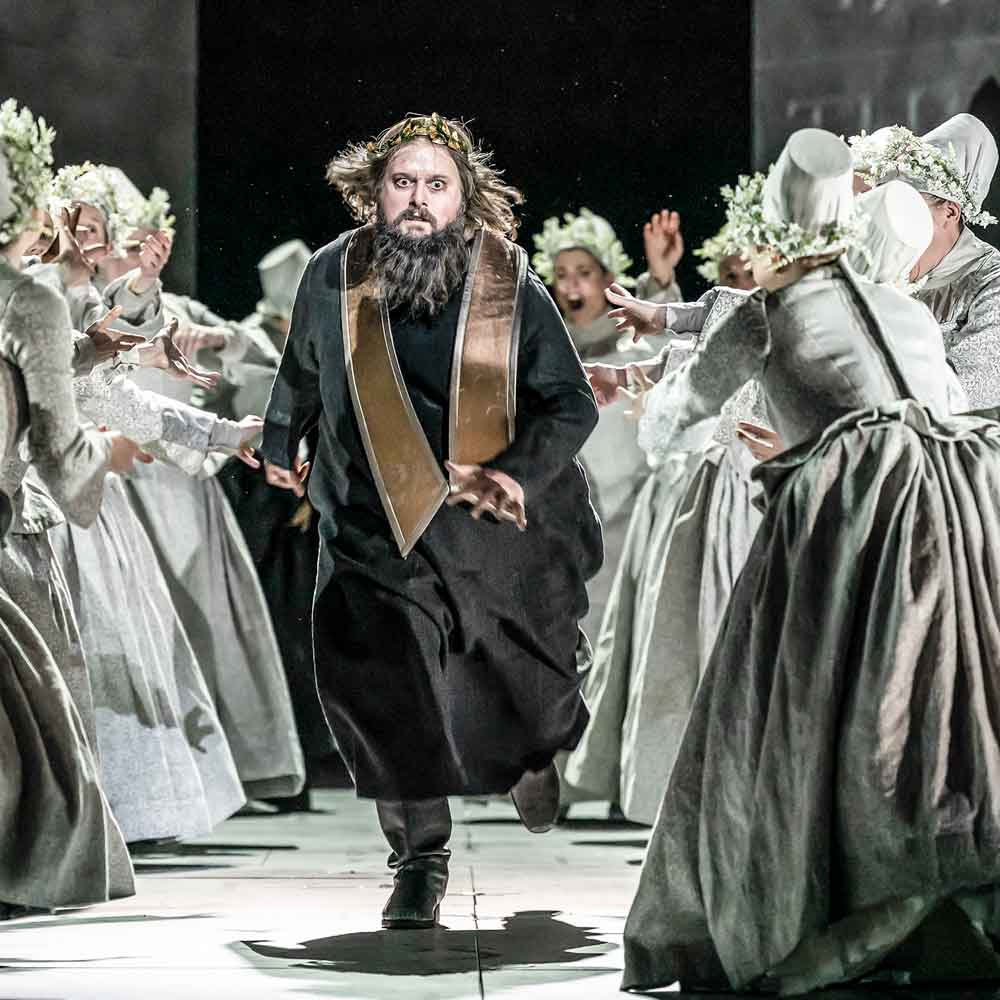
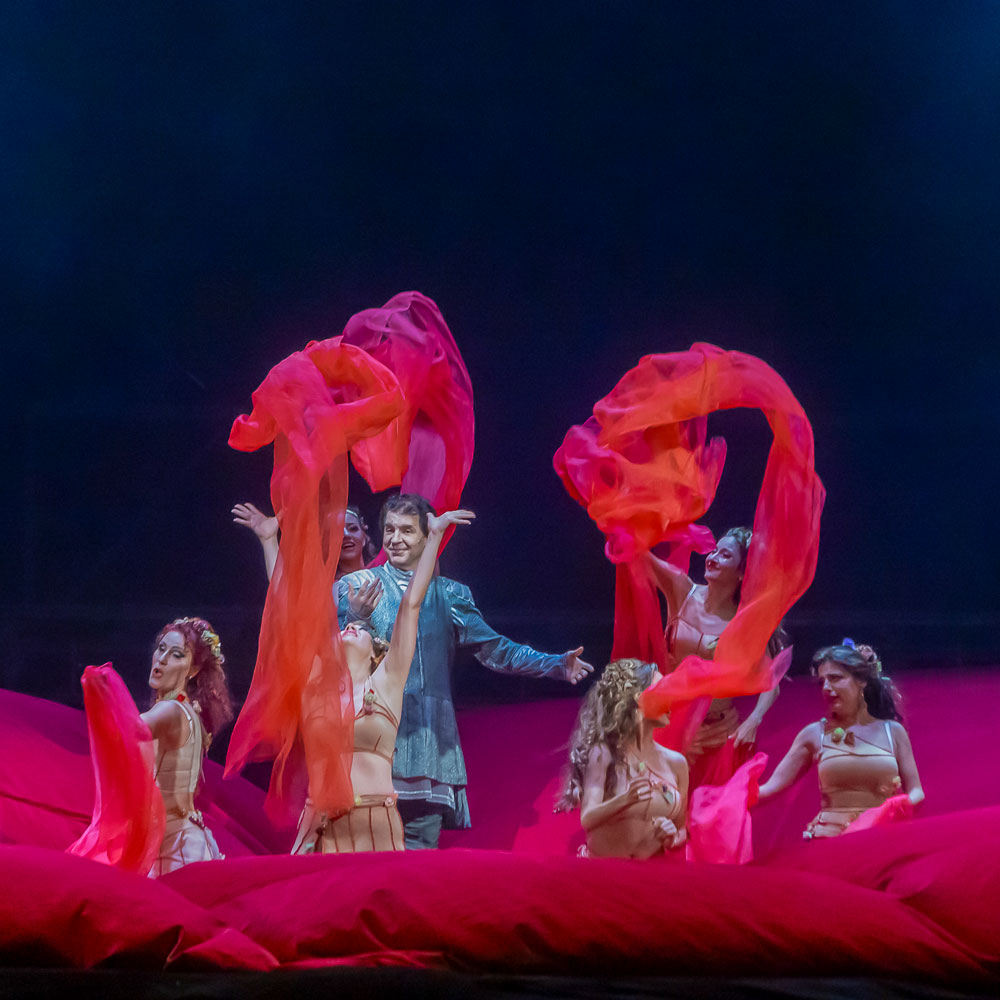
In the midst of this musical chaos, the actual production itself scrubbed up well. Laurent Pelly’s work is a mediaeval, multi-coloured, supernatural, Gothic picture-book. Ladies-in-waiting each have their own bright colour – a colour which goes from their long pointed hats and painted faces to the tips of their toes. A flurry of different-coloured plastic horses grace the stage. Isabelle, Princess of Sicily, stands atop a castle half her size. A huge cardboard cut-out of a bottle of wine makes its presence felt for three acts without serving any particular purpose. At the end of the third act, a group of dead nuns convulse and swirl in a Bacchanalian manner with the hope of seducing Robert. It was the Gothic Absurd layered on top of the Gothic Absurd. It had nothing to do with the music – thank God - but it did represent some of Eugène Scribe’s libretto.
Bryan Hymel gave a powerful rendition of Robert Le Diable’s vocal part, for all the superfluous chromatic scales and broken chords it involves. His voice is a pure, solidly trained and potent tenor which passed through the high notes flawlessly and conquered most of the coloratura with ease. John Relyea’s Bertram provided a fierce opponent to Robert, with a booming bass voice that was easily able to administer the lowest of notes and hold them there for many beats. His higher register was a little shaky, but that might be because the vocal part for bass in Robert Le Diable exceeds the possibilities of bass. It certainly might have likewise been the case for Marina Poplavskaya’s soprano as Alice, which remained a long way from meeting the conditions of the role although it hardly exceeds the usual feats reached by sopranos. Her deliverance of the chromatic scales and coloratura required for the part was shaky, often reached the point of squealing, and included several breaths she shouldn’t have taken. At the beginning of the opera it even seemed that some of her high notes were nearing falsetto, and her voice is such that, as has been demonstrated on other occasions, it is her middle, mezzo register for which she preserves her vocal strength. She allows her top sector to work for itself, not providing it with the diaphragmatic push that it so badly needs. This results in many of her high notes withering and slipping away before they can be firmly rounded off. Isabelle’s part, the most decorated and fairy-like part of them all – slightly similar to the Fairy Godmother in Massenet’s Cendrillon - was for the most part executed beautifully. Sofia Fomina, called in to replace Jennifer Rowley at the last minute, showed evidence of fine vocal training and a voice that was tailored for high notes and intrinsic coloratura. In the fourth act especially, she supplied the opera’s only favourable piece, her aria “Robert, toi que j’aime”, with the most vocally solid embellishments and an array of piercingly thrilling high notes. Her singing throughout the evening was totally fluid, containing an equal amount of strength in easier passages as it did in the chromatic scales conducted in the highest registers.
Daniel Oren’s conducting was the most which this Meyerbeer opera deserved. Generally waltz-like or alla marcia, Oren simply didn’t possess an awful lot of music with which to experiment. His conducting was clean-cut, technically accurate and aboveboard, and there was little he could have added to redeem the work. In the duets and trios with an unnecessary splash of glistening high notes and decorative patterns echoing again and again, there was little character the orchestra could give to save this opera. Thankfully however, it didn’t stress it too loudly or melodramatically.
This brings us back to the question of Wagner’s credibility. Wagner was a mean-tempered, anti-Semitic, bad-mouthed man. He led a campaign against a composer who had at first in some ways influenced him, provided him support for his Rienzi, and both financed and publicised his works. But he did state, quite famously, that Meyerbeer’s operas were “effects without causes”. And he did have a point.
Sophia Lambton
Photo by Bill Cooper
|
|
|
|
|
|
|
|
|
|
|
|
|
|
|
|
|
|
|
|